
The Wildlife Trade in Equatorial Guinea
Categories: Journal no. 72, Bushmeat, Other countries, Western Lowland Gorilla
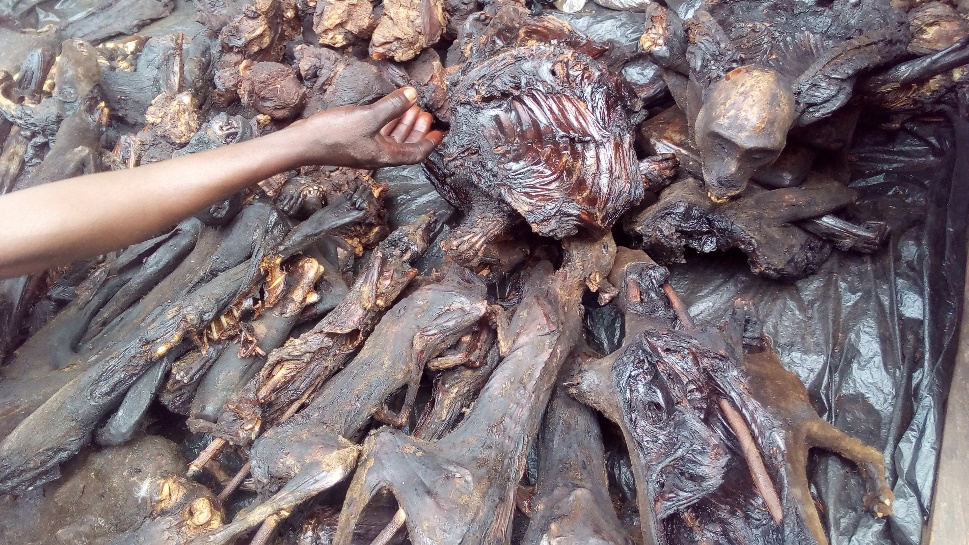
Bushmeat in Nigeria: In a study by Tengwood, "monkey" was very popular on markets. (© Tengwood Organization)
In tropical Africa the bushmeat trade is still very common. Some species are also killed or captured for other reasons: for body parts which can be sold in urban markets, or for the local, domestic, or international pet trade.
A study in 1990 surveyed the wild meat trade in the two main markets of Equatorial Guinea (Malabo on Bioko Island and Bata on the mainland coast). At that time, harvesting was unsustainable for two of the 17 species in the mainland: the western gorilla and the common chimpanzee. Most species were hunted sustainably. In 2025, a new survey monitored wild-trapped and shot vertebrates offered for sale in Bata and Malabo, plus wildlife sold along roads and villages across the country.
The 2025 surveys documented an extensive wildlife trade, mainly for meat consumption. Pangolins are of particular note: they are traded for body parts, and their meat is considered a delicacy. Most of the animals offered in the markets were mammals (80.0 %), followed by reptiles (14.1 %) and birds (5.9 %). 94.2 % of the animals were marketed for meat consumption, of which mammals made up 82.7 %. 4.4 % of cases were body parts offered for medicinal or ritual purposes (e.g. elephant tails, skulls and hands of primates including western gorilla and common chimpanzee). Only 1.4 % of the animals were offered as pets, mostly grey parrots.
The majority of the animals on the markets were freshly dead, 11 % were smoked, 5.1 % were alive (mostly reptiles and pangolins), and 0.5 % were rotten. In other Central African countries, such as the Democratic Republic of the Congo, wild meat is usually smoked in order to be transported to markets, which requires long and difficult journeys. In Equatorial Guinea a road network now covers 2,900 km in a country with an area of 28,000 km². This facilitates the transportation of fresh and live animals.
There were important changes in species composition at the two markets between 1990 and 2025. A decline in primates and ungulates was observed, while carnivores, pangolins, birds and reptiles increased. These changes could indicate population reductions of certain taxa and their replacement by others in the markets.
Of the species offered at the markets in 1990, only the western gorilla and common chimpanzee were globally threatened according to the IUCN Red List. In 2025, 15 species were regarded as globally threatened and 8 as Near Threatened (NT): 26.8 % and 14.3 % of the total species recorded. Forest elephant, western gorilla and Bioko black colobus are listed as Critically Endangered (CR); common chimpanzee, red-eared monkey, white-bellied pangolin, giant ground pangolin and grey parrot) are listed as Endangered (EN). Of the total individuals surveyed in 2025, 17.4 % were globally threatened and 3.9 % Near Threatened.
An increase in hunting over decades may have caused the population decline of several species. A nation-wide survey in 2011 showed strong hunting pressures on large mammals even within protected areas. Hunting for food and medicinal products is a major global driver of extinction for terrestrial mammals. Current information suggests that hunting is unsustainable for many species traded in Equatorial Guinea. These species are more valued and as a result are scarcer and more difficult to find than decades ago.
The country's economic growth in recent decades has facilitated access to large tracts of previously inaccessible forests through new roads and highways. Vehicles and firearms are easier to access. Human population growth since 1990 has increased hunting pressure on wildlife. Urgent conservation actions are required. Although hunting of several threatened species is prohibited by national laws, they are openly sold in the markets and streets of rural settlements, often right in front of the authorities. It is difficult to replace wild meat as it still is a relatively cheap and easy-to-obtain protein resource. Further, wild meat is preferred socially and traditionally over domestic meat. Targeted educational campaigns may change consumer attitudes towards wild meat and reduce its demand.
Original publication:
Tella, J. L., Palacios-Martínez, I., Romero-Vidal, P., Blanco, G. & Juste, J. (2026): Wildlife consumption is widespread across Equatorial Guinea and hunted species are more threatened now than 35 years ago. Biological Conservation 316, 111775