
Female Networks
Categories: Journal no. 72, Behaviour, Mountain Gorilla
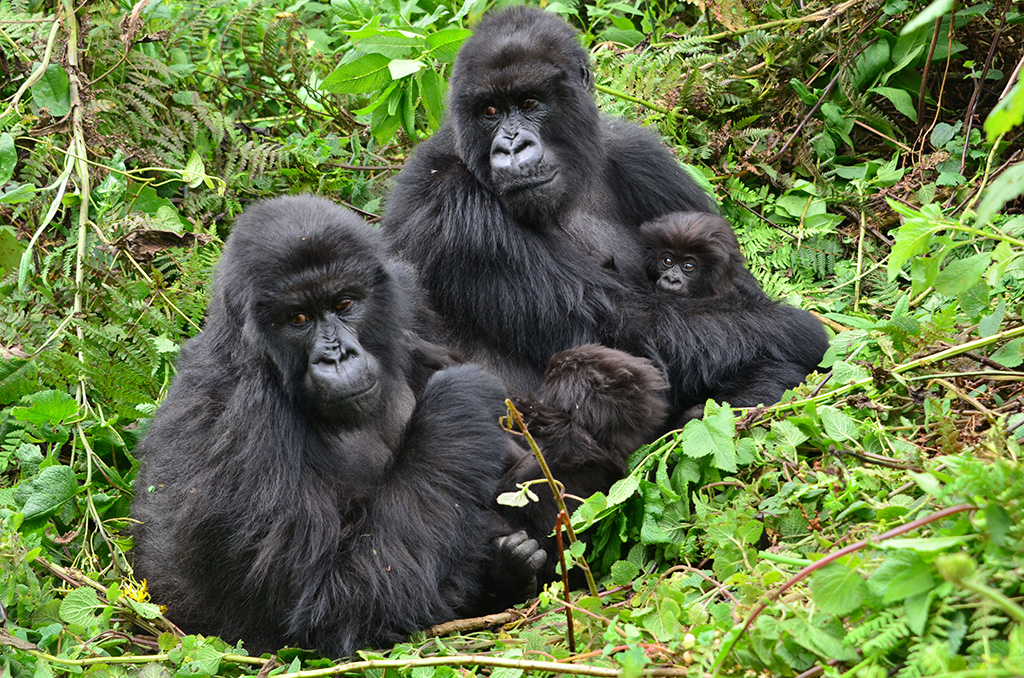
Three generations of mountain gorillas sitting together. Gutangara holding her infant daughter, next to her adult daughter Shishikara and grandson Kira (© Dian Fossey Gorilla Fund)
In many animal societies, individuals of one sex, and sometimes both, eventually leave their natal group to join another. In a smaller number of species, including humans and gorillas, individuals may change groups multiple times throughout their lifetime. This process, known as dispersal, plays a central role in avoiding inbreeding, promoting gene flow, and shaping social relationships.
Despite its prevalence and importance, dispersal remains incompletely understood. Most research has focused on the first stage of the process, departure, and has sought to explain why individuals leave in the first place. By contrast, the second stage, where individuals go after dispersing, has remained largely unexplored, partly because it is particularly difficult to track individuals once they have left their group.
In mountain gorillas (Gorilla beringei beringei), males typically become solitary during dispersal, whereas females transfer directly from one social unit to another. However, the factors that shape these destination choices remain poorly understood. The aim of our study was therefore to reconstruct the social histories of individuals in order to better understand how dispersal decisions are made. Using more than 20 years of data from the Dian Fossey Gorilla Fund, we show that dispersal destinations are far from random. Broad group characteristics, such as sex ratio or group size, had little influence but past social experiences were particularly important. Females avoided groups containing males with whom they had grown up and preferentially joined groups containing familiar females.
Because female mountain gorillas can live in groups with multiple males, paternity is often uncertain. Avoiding males they grew up with may therefore represent a strategy to reduce the risk of inbreeding, as the probability of relatedness is likely higher with familiar males from the natal group than with males from other groups.
What proved especially important for females was the presence of familiar females, particularly those with whom they had previously spent several years. Joining a new group can be risky, as resident females often show aggression toward immigrants. Selecting a group that contains pre-existing social partners may therefore facilitate both social acceptance and faster integration into the new group.
These findings suggest that dispersal is not only about avoiding inbreeding or finding mating opportunities but is also strongly shaped by same-sex social relationships. It is often assumed that individuals who disperse repeatedly will invest less in social bonds, as they or their partners may leave at any time. However, our results challenge this view. Rather than ending social bonds, dispersal can allow individuals to reconnect with previous partners, even after years apart. This highlights the long-term importance of social relationships and suggests that social bonds can persist beyond group boundaries.
Victoire Martignac
Original publication
Martignac, V., Eckardt, W., Mucyo, J. P. S., Ndagijimana, F., Stoinski, T. S., Vecellio, V. & Morrison, R. E. (2025): Dispersed female networks: female gorillas' inter-group relationships influence dispersal decisions. Proceedings of the Royal Society B: Biological Sciences 292, 20250223