
Overview of Management Activities in the Itombwe Nature Reserve in 2025
Categories: Journal no. 72, Threats, Ecology, Democratic Republic of the Congo, Itombwe, Grauer's Gorilla
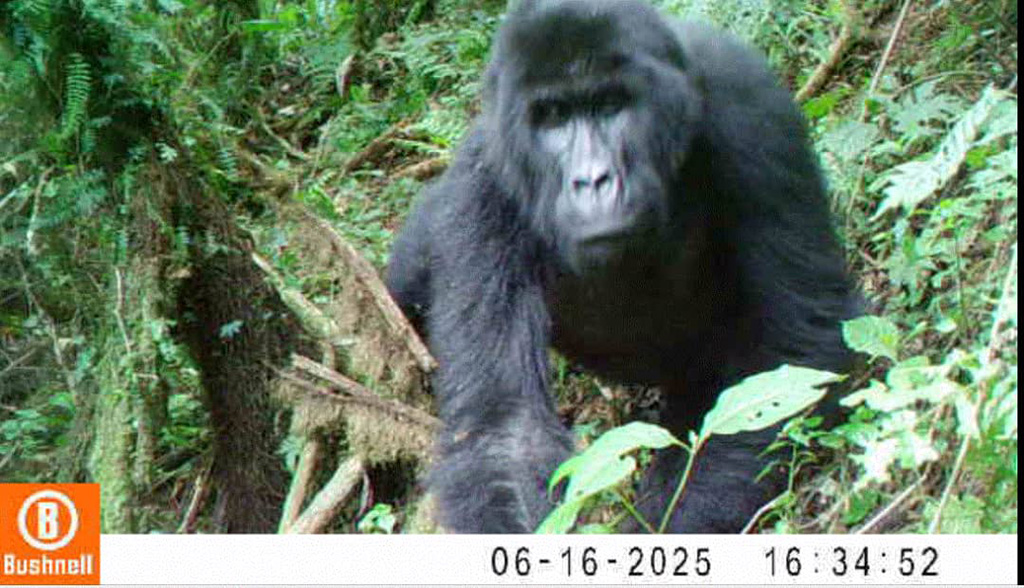
A gorilla caught by a camera trap (© ICCN-RNI)
The Itombwe Nature Reserve (INR), like all protected areas in the eastern part of the Democratic Republic of the Congo, faces countless management challenges due to insecurity and armed conflict. During 2025, the INR operated in an adaptive manner in response to the persistent security instability. This situation has had negative repercussions across all sectors of life, including nature conservation.
The INR continued to benefit from the support of its partners, including Berggorilla & Regenwald Direkthilfe, Primate Expertise, The Gorilla Organization, ACOPED (Community Action for the Promotion of the Environment and Sustainable Development), and Strong Roots. Thanks to this support, and despite the difficult working conditions, several activities were carried out, notably surveillance patrols, species monitoring through camera traps, environmental awareness and education, monitoring and evaluation, as well as other routine activities.
Over the past few months, the security situation within the Itombwe Nature Reserve has shown gradual improvement. Peripheral areas are now under the control of the Armed Forces of the Democratic Republic of the Congo (FARDC) and the Wazalendo groups, armed patriotic groups defending the nation.
Surveillance and Protection of the INR
As part of ongoing efforts towards conservation and sustainable natural resource management, 29 surveillance patrols, including 23 camping patrols, were conducted across three sectors: Mulambozi, Ulindi, and Elila. These patrols were organised not only to address the multiple threats facing the biodiversity of the INR, but also to strengthen sector coverage and ensure effective law enforcement through the active presence of ICCN staff in the field. Patrol orientation and planning were guided by the distribution of conservation targets through SMART analyses and available intelligence data concerning threats within the protected area.
In terms of human effort and time, the 29 patrols extended over 192 days and involved 1,121 ranger-days. The results of these patrols were as follows:
- 21.8 % total coverage of the protected area;
- Recording of several images and videos of gorillas, chimpanzees, and many other wildlife species;
- Arrest, awareness-raising, and sensitisation of 30 poachers;
- Seizure of one firearm and 00 buckshot cartridges;
- Removal of 721 traps;
- Seizure of one spear;
- Closure of 10 pitfall traps;
- Seizure and destruction by burning of 153 pieces of smoked bushmeat;
- Destruction by fire of 14 campsites.
Distribution of great apes (gorillas and chimpanzees) in the INR in 2025
Common name | Scientific name | Elila Sector | Mulambozi Sector | Ulindi Sector | Total |
Chimpanzee | Pan troglodytes | 115 | 207 | 9 | 331 |
Gorilla | Gorilla beringei graueri | 0 | 384 | 0 | 384 |
Giant pangolin | Smutsia gigantea | 2 | 0 | 0 | 2 |
Total |
| 117 | 591 | 9 | 717 |
Awareness-raising, Environmental Education and Community Conservation
The objective of this programme is to strengthen and maintain the involvement of neighbouring communities in the conservation of the reserve and integrated community development. During 2025:
- A total of 626 people were reached through awareness activities, including 264 schoolchildren, 118 older pupils, 67 teachers, and 177 other community members. During these sessions, participants showed great interest in learning about the importance of the INR, its objectives, conservation targets, and anthropogenic threats. They asked many questions about ways to protect these natural habitats. Several participants were surprised to learn that certain species exist only within this specific area and that their disappearance would have an irreversible impact on the environment. The main recommendations made by participants during the sessions with ICCN/INR were to:
- strengthen awareness sessions in all schools neighbouring the INR;
- organise inter-school competitions;
- establish environmental clubs within schools to continue raising awareness, among others; and
- support schools in setting up school gardens.
- Production and distribution of 1,000 calendars within spheres of influence including police stations, hospitals, churches, and other key institutions.
- Radio broadcasts on compliance with zoning regulations and the prohibition of killing fully protected animal species in the DRC. This programme reached approximately 2,700 people living around the reserve.
Challenges Affecting the Management of the INR
- Insecurity in certain sectors of the INR;
- Insufficient infrastructure within sectors and ranger posts;
- Some parts of the reserve still lacking clearly demarcated boundaries;
- Very limited staff numbers to control the entire reserve: 40 staff members for 5,372 km²;
- Insufficient equipment for surveillance, data collection, and data processing.
Addressing these challenges would improve the management of the INR.
Claude Sikubwabo Kijengo and Séguin Caziga Bisur