
The Itombwe Nature Reserve: A Jewel at the Heart of the Itombwe Forest Massif
Categories: Journal no. 72, Threats, Democratic Republic of the Congo, Itombwe, Grauer's Gorilla
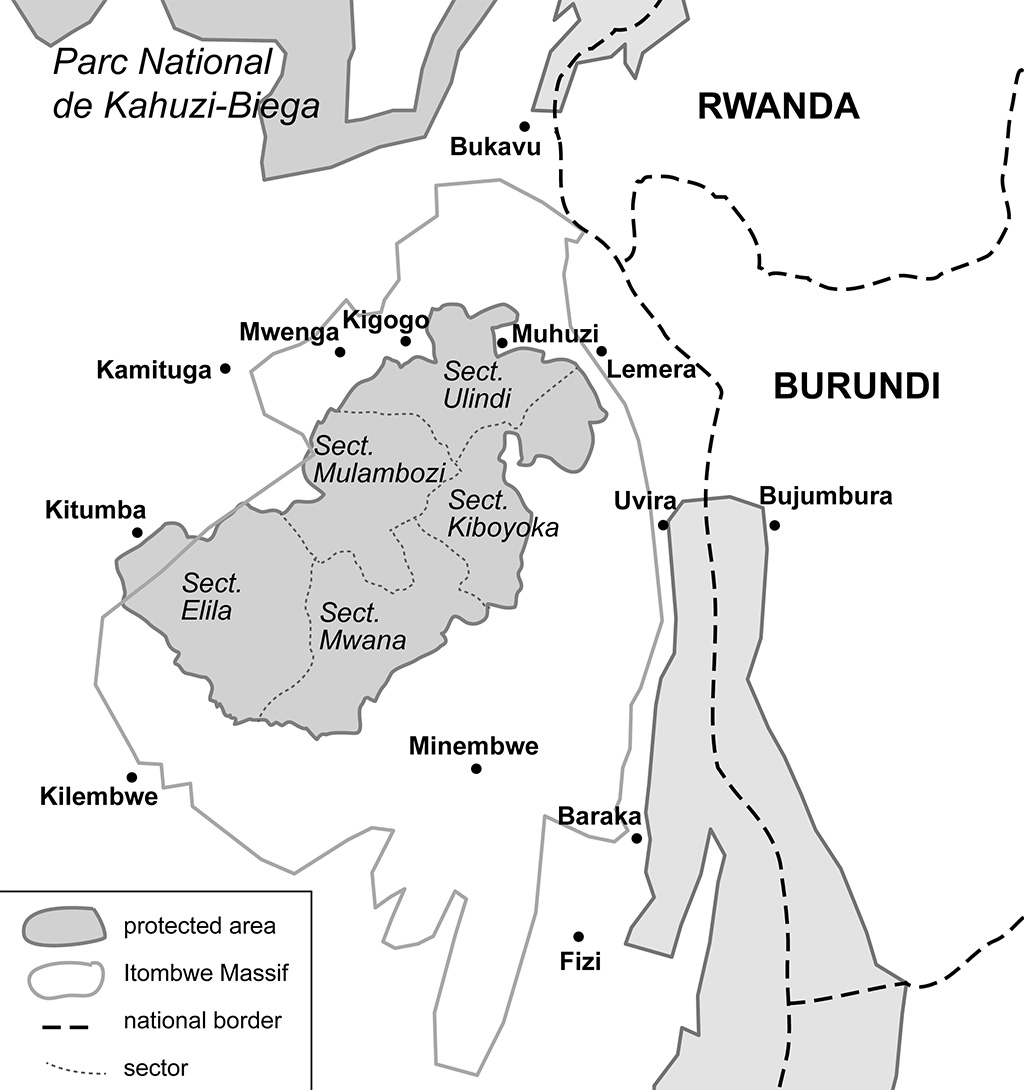
The Itombwe Nature Reserve and its sectors (© Angela Meder)
The Itombwe Nature Reserve (INR), located in eastern Democratic Republic of the Congo (DRC), is a sanctuary with exceptional biodiversity and a source of international scientific interest. It is home to a unique flora and fauna, including numerous endemic and endangered species. Yet it faces a multitude of challenges, ranging from geopolitical pressures to direct threats to its ecosystem. This article analyzes the ecological, political, and institutional dimensions of the reserve, as well as its crucial role in the global fight against climate change.
Introduction
Nestled in the heart of the Itombwe forest massif located northwest of Lake Tanganyika in South Kivu Province, the Itombwe Nature Reserve is an ecological gem of the DRC. Established by Ministerial Decree No. 038/CAB/MIN/ECN-EF/2006 of October 11, 2006, it is a jewel at the heart of the Itombwe forest massif, ranked among the richest biodiversity zones on the African continent; it is also considered a living laboratory for science and conservation. The Itombwe Massif represents the largest area of sub-montane forests in Africa. This massif, covering approximately 12,000 km², includes a continuous forest zone - the central massif - covering 6,500 km² at altitudes reaching up to 3,700 m.
The central massif harbors several exceptional forest habitats: bamboo, moorlands, humid transitional Miombo zones, and a high-altitude ecotone wooded savanna, as well as dense forest. It is home to significant populations of eastern chimpanzees (Pan troglodytes schweinfurthii) and critically endangered Grauer's gorillas (Gorilla beringei graueri). The Itombwe Massif represents one of the most favourable zones for the conservation of great apes and endemic biodiversity of the Albertine Rift highlands. However, the coexistence between its natural wealth and human and political challenges is complex and sometimes conflicting or divergent.
Geopolitical and ecological context. The INR is located in the Albertine Rift region, a mountainous area with a high rate of endemism. This region is geopolitically unstable due to the multiple wars and ethnic conflicts also affecting the highlands, which drive populations to displace into the reserve to establish refugee settlements, engaging in mineral extraction for survival, with all the ecological consequences.
The DRC, although endowed with exceptional natural wealth, faces political tensions and security challenges that complicate the implementation of effective conservation policies. In this context, several threats directly weighing on the biodiversity of the Itombwe Nature Reserve can be cited: illegal deforestation for agriculture or charcoal; poaching threatened emblematic species such as the Grauer's gorilla, chimpanzee, etc.; artisanal mining within and semi-industrial mining in zones near the INR (at Kitutu near the Elila sector and at Twangiza near the Ulindi sector); and demographic pressures from the creation of villages expanding to within the reserve's boundaries for agricultural and mining purposes.
Resilience of Conservation Actors
Despite the threats, several local and international actors contribute to the preservation of the INR. These include local community organisations such as the NGO ECO-CITOYEN, headquartered in Mwenga centre, which is involved in Conservation/Development, the protection of large primates, and environmental education by training the population in ecological citizenship and community development. Local populations are also involved in ecological surveillance through the innovative system of "Community Patrols at the INR". Some international NGOs, notably Berggorilla & Regenwald Direkthilfe, contribute their expertise and financial resources in support of eco-guards and the purchase of rations for biomonitoring patrols, while also providing socio-economic support for local development (schools, lighting, etc.). Researchers, within the limits of their capacity, document biodiversity and propose sustainable solutions. The Pygmy indigenous peoples living in the chiefdoms of Lwindi, Basile, and Wamuzimu in the Mwenga Territory possess intimate traditional knowledge of the ecosystems, informing INR staff on the importance of conserving certain natural resources for their medicinal value, customary rites, the embodiment of traditional authority, and traditional totems, among others.
Ecosystem Functions of the Reserve in the Face of Climate Change
The Itombwe Nature Reserve plays a strategic role in the fight against climate change, both locally and globally, as follows:
Carbon storage. The Itombwe forests absorb and store millions of tonnes of CO2 in their biomass. This capacity to sequester carbon makes it a powerful carbon sink, essential for mitigating the effects of global warming. However, the exact assessment of the tonnes of carbon sequestered by the Itombwe Nature Reserve remains partial and ongoing, due to the lack of implementation of the management plan and regular ecological forest biomass inventories, unlike the biomonitoring activities carried out by the eco-guards.
Despite this, through a scenario approach, the carbon sequestration potential can be estimated based on the area and density of the INR's forests - approximately 573,200 hectares. Given that tropical rainforests such as that of Itombwe can store between 150 and 300 tonnes of carbon per hectare, depending on their density and conservation status, an example calculation using 225 tC/ha yields the following median sequestration estimate: 573,200 ha × 225 tC/ha = 129 million tonnes of carbon stored by the INR.
Protection against natural disasters. The forest ecosystems of the Itombwe Massif reduce the risks of erosion, flooding, and landslides, which are exacerbated by climate change. They act as ecological buffers, stabilizing soils and regulating hydrological cycles.
Preservation of resilient biodiversity. The reserve is home to endemic species such as the Grauer's gorilla and other flagship species such as chimpanzees and buffaloes, which are indicators of ecosystem health. Rich biodiversity promotes ecological resilience, meaning the ecosystem's capacity to adapt to climatic disturbances.
Support for local communities. The Itombwe forests provide vital resources (water, medicinal plants, wood) to surrounding populations. Protecting the INR therefore promotes sustainable management that can improve food security and reduce community vulnerability to climatic and economic hazards. Some authors have subdivided these forms of support as following:
- Source of income: The INR can attract tourists, particularly owing to its biodiversity and unique landscape. This could generate revenue through entrance fees, ecotourism services, accommodations, and local guides, once the security situation permits and visits are organized.
- Job creation: The management of the INR mobilizes several professional categories: conservators, eco-guards, researchers, artisans, community patrollers, etc. This enables local professional integration.
- Valorisation of natural resources: The INR integrates sustainable use of resources (fishing, non-timber forest products, artisanal mineral extraction, etc.), allowing communities to derive benefits without compromising their regeneration.
- Support for basic social services: Through funds generated by conservation (external funding, public/private partnerships, trust funds, etc.), the INR supports the construction of schools, funding of agriculture, livestock farming, income-generating activities, health centers, and other vocational training.
- Framework for scientific research and education: The INR serves as a site for teaching ecology, biogeography, and sustainable development sciences, as well as for traditional initiation.
- Contribution to international commitments: The INR is part of the DRC's efforts to uphold the Paris Agreement and the Sustainable Development Goals (SDGs). It is also supported by partners such as Berggorilla and The Gorilla Organization within the framework of conservation projects.
Challenges. All these vital functions make the INR a key actor in climate regulation, biodiversity protection, and support for local populations. Its preservation is therefore an ecological and human priority. It should be noted, however, that notwithstanding its ecological stakes and adaptation strategies, the INR is unfortunately fully subjected to the effects of climate change, which exert increasing pressure on it, altering its ecological balances and threatening its biodiversity through certain factors such as:
- Disruption of climatic cycles
Alteration of seasons: Rainy and dry periods have become unpredictable, affecting species reproduction and the agricultural cycles of local communities. This type of disruption frequently occurs in Mwenga centre, where farmers experience miscalculations in seasonal planting schedules. These irregularities are common in that one period may become longer than the other, causing the destruction of crops in the fields.
Reduction in precipitation in certain zones, leading to the drying out of marshes and declining river levels. This is the case for the Ulindi, Kitongo, Kikuzi, Zalya, and other rivers, which can be crossed on foot during dry seasons. - Increased risk of natural disasters
Soil erosion due to more intense and irregular rainfall.
More frequent forest fires during prolonged dry periods, threatening carbon-rich forested areas. - Increased vulnerability of biodiversity
Endemic species such as the Grauer's gorilla are already threatened by poaching and habitat loss. According to Plumptre et al. (2021), scientists sought to assess the impact of civil war on Grauer's gorilla populations, estimated at 17,000 individuals before the conflict in eastern DRC. The survey results confirmed their worst fears: numbers had fallen to approximately 6,800 individuals - a decline of more than half over 26 years. This study conducted by WCS in 2020 and published in 2021 at the Itombwe Nature Reserve in the Mwana Valley reported a critical status for these great apes. The results of the latest census showed that due to poaching, the number of gorillas living in this valley had dramatically decreased, falling from 211 individuals in 1996 to 73 individuals in 2020, the year the report was published.
Conclusion
The Itombwe Nature Reserve is not only a sanctuary for wildlife but also a barometer of conservation efforts in Central Africa. Its safeguarding requires coordinated commitment among institutions, local communities, and international partners. In a world facing ecological crisis, preserving the Itombwe Nature Reserve means acting for the future of the planet.
John Baliwa Kitoga Ngoy
References
Bisidi, Y. (2008): L'utilisation et la conservation des ressources forestières à Itombwe: Perception de la population. WWF-ESARPO
De Failly, D., & Bantu, J.-M. (2010): La forêt d'Itombwe: Enjeux socio-économiques et conservation de la nature en contexte congolais. Étude de cas à dimension multiple. Grenoble, France: Terre Citoyenne & Association des Populations des Montagnes du Monde
Doumenge, C. (1990): La conservation des écosystèmes forestiers du Zaïre. Programme pour les forêts tropicales, IUCN
Doumenge, C. & Schilter, C. (1997): Les Monts Itombwe: D'une enquête environnementale et socio-économique à la planification d'interventions au Zaïre. Gland, Suisse: UICN
Igunzi Alonda, F. (2017): Potentialités écologiques et socioculturelles des Malambo: Stratégie d'inscription de la Réserve Naturelle d'Itombwe comme site Ramsar. Mémoire soutenu à l'Université Senghor
Ministère de l'Environnement RDC (2022): Rapport sur les Aires Protégées
Mubalama Kakira, L. (2018): Statut et gestion des aires protégées. Éditions de l'Université Officielle de Bukavu
Muhigwa, J.-B. et al. (2014): Le massif d'Itombwe : Le peuple et la terre (Sous la dir. de D. de Failly & C. Katcho Karume). Namur, Belgique, Les Éditions Namuroises
Plumptre, A. J. et al. (2007): The biodiversity of the Albertine Rift. Biological Conservation, 134 (2), 178-194
Plumptre, A. J. et al. (2016): Statut du gorille de Grauer et des chimpanzés à l'est de la République Démocratique du Congo: distribution et abondance historique et actuelle. Kinshasa: WCS, ICCN, FFI
Plumptre, A. J. et al. (2015): Statut du gorille de Grauer et des chimpanzés à l'est de la République Démocratique du Congo: distribution et abondance historique et actuelle. New York: Wildlife Conservation Society
Plumptre, A. J. et al. (2021): Changes in Grauer's gorilla (Gorilla beringei graueri) and other primate populations in the Kahuzi-Biega National Park and Oku Community Reserve, the heart of Grauer's gorilla global range. American Journal of Primatology 83 (7), e23288
UICN-Programme Aires Protégées pour l'Afrique du Centre et de l'Ouest (PAPACO) (2010): Parcs et réserves de la République Démocratique du Congo Evaluation de l'efficacité de la gestion des aires protégées. Ouagadougou: UICN/PACO