
Hope Grows on the Mountain: Rewilded Grauer's Gorillas Flourish
Categories: Journal no. 71, Success Stories, Gorilla Groups, Democratic Republic of the Congo, Mt. Tshiaberimu, Grauer's Gorilla
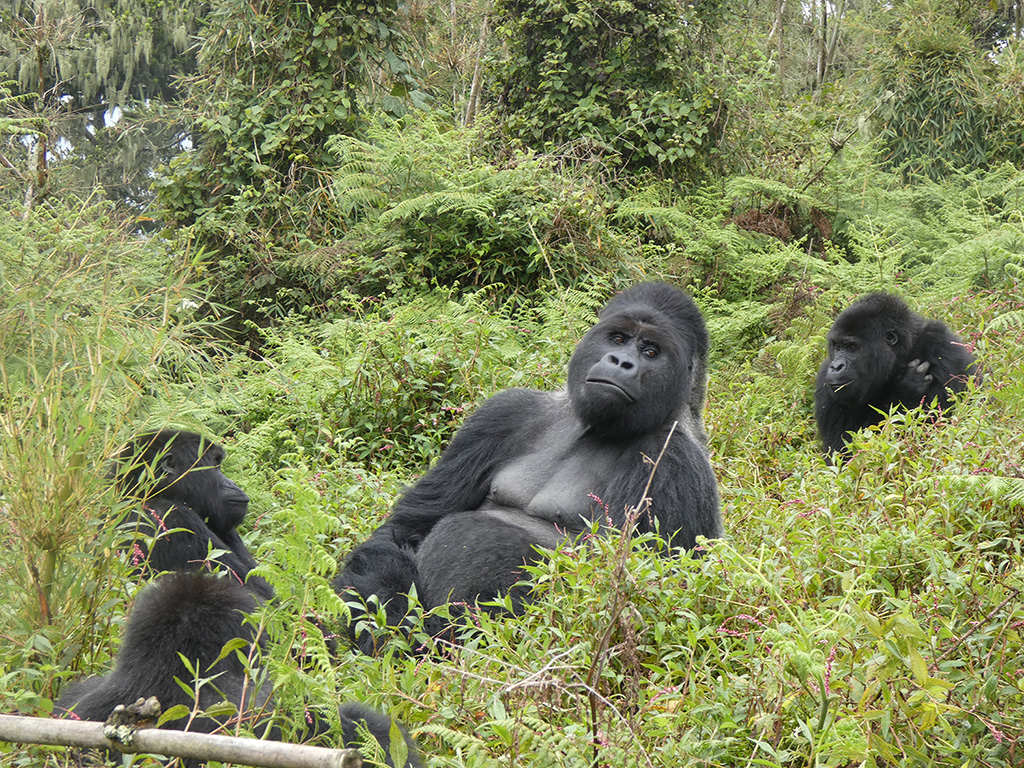
Members of the family group with silverback Mwasa in the middle (© GRACE)
The project partners are thrilled to share encouraging news from Mt. Tshiaberimu in Virunga National Park, where four female Grauer's gorillas - Isangi, Lulingu, Mapendo, and Ndjingala - were rewilded from the Gorilla Rehabilitation and Conservation Education (GRACE) Center in late 2024. This effort marked the first time gorillas rehabilitated at GRACE were returned to the wild, and it represents the largest successful Grauer's gorilla translocation ever completed.
Integration and Behavior
The four females have successfully joined wild silverback Mwasa's group, which also includes juvenile gorilla Kavango. All four females are in excellent physical condition, with healthy coats, long hair, and strong appetites. They are feeding, foraging, nesting, and displaying natural social behaviours, including mating. The females have been observed grooming one another and Mwasa and showing maternal care toward young Kavango. Mwasa is a protective and attentive silverback, sharing his nest with Kavango.
Group Interactions
Mwasa's group is not alone on the mountain. A second family group, led by silverback Katsabara (or Katsavara), also inhabits Mt. Tshiaberimu. Encounters between the two groups have so far remained peaceful. Recently, the females from both groups mingled for about ten minutes before separating, while the two silverbacks kept their distance. Such intergroup interactions provide opportunities for females to transfer between groups, a natural process that can shape gorilla social dynamics. The massive size of silverbacks is thought to play a role in protecting and defending females from transferring out of their groups. Although Mwasa occasionally approaches Katsabara, the latter appears to retreat to protect his family and infant. Both groups are feeding in overlapping areas, primarily on bamboo and Basella, without incident.
Conservation Significance
An analysis showed that the population of gorillas on Mt. Tshiaberimu needed a boost in genetic diversity, and unless new gorillas were moved there, the isolated gorillas living in that area would eventually go extinct. This rewilding effort increased the Mt. Tshiaberimu Grauer's gorilla population from 8 to 12 individuals, reducing the extinction risk to less than 1 %.
The project was the culmination of more than a decade of rehabilitation and over three years of detailed planning and coordination among local communities, GRACE, Re:wild, Gorilla Doctors, Virunga National Park, and the Congolese Institute for the Conservation of Nature (ICCN), supported by a Project Advisory Committee of more than 20 international experts. Every step aligned with IUCN Best Practice Guidelines for Great Ape Reintroduction.
Looking Ahead
The story of Isangi, Lulingu, Mapendo, and Ndjingala is one of resilience, collaboration, and hope. Their successful reintroduction offers not just a lifeline for the gorillas of Mt. Tshiaberimu, but also a model for how communities, conservationists, and partners worldwide can come together to secure a future for one of the planet's most endangered great apes.
GRACE Gorillas, Gorilla Doctors, Re:wild and Virunga National Park
Credits
This historic rewilding is the result of a project partnership between the Gorilla Rehabilitation and Conservation Education Center (GRACE Gorillas), Gorilla Doctors, Re:wild, and Virunga National Park, supported by the European Union, Arcus Foundation, Disney Conservation Fund, Explore.org, a direct charitable activity of the Annenberg Foundation, Margot Marsh Biodiversity Fund, QATO Foundation, U.S. Fish and Wildlife Service, and Frankfurt Zoological Society.