
Female Mountain Gorilla Have Some Power Over Males
Categories: Journal no. 71, Gorilla Groups, Behaviour, Uganda, Bwindi, Mountain Gorilla
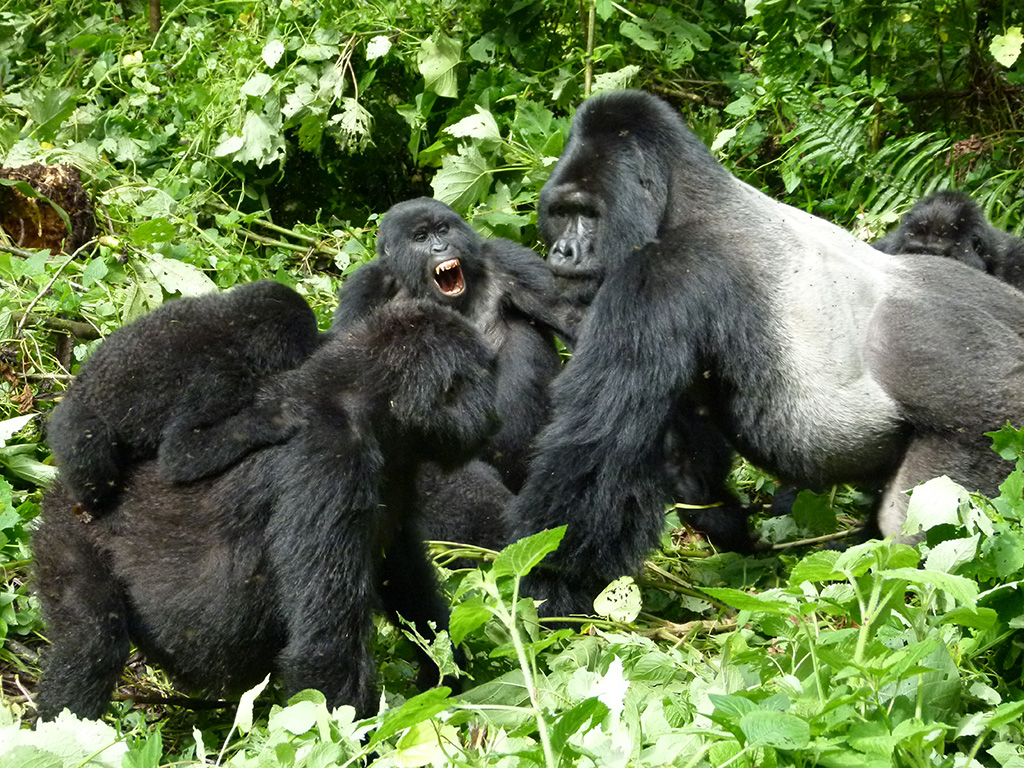
A silverback in Bwindi National Park charging to show his power (© Martha Robbins)
Males have been long assumed to strictly overpower females in most mammals. Recent research questions this assumption suggesting that female-male power* relationships vary along a continuum from strictly male- to strictly female-biased. We wanted to investigate female-male power relationships in gorillas, because not only are males much bigger than females and have much larger canines, they are also typically considered to exhibit the strictest male-biased power over females among great apes and male gorillas are often depicted as a ‟male power archetype‟ across animals. At the same time, we knew that females have some control or power over males because females can transfer between groups, effectively deciding which male they want to reproduce with.
We used behavioural data over 25 years from four groups of wild mountain gorillas living in Bwindi Impenetrable National Park, Uganda. Specifically, we used avoidance and displacement interactions to infer power/dominance relationships, a common process in studies of mammals including gorillas. We found that males generally have more power (rank higher) than females, and the highest-ranking male is never overpowered by females. However, we also observed that power is not strictly determined by sex and females can overpower other males. Almost all females had more power than at least one adult male (silverback) in multi-male groups.
Previous research on power relationships in gorillas and other mammals mostly focused on contests among individuals of the same sex assuming that males overpower females ‟by default‟, but also assuming that males and females compete over different resources: males over females, and females over food. Our study suggests that females and males in fact often compete directly over access to resources. Specifically, power relationships between female and male gorillas determined priority of access to decaying wood, a rare resource and a critical source of sodium for gorillas. When a female overpowers a male, she always had priority over him in the context of feeding on wood.
Altogether, our findings suggest that even in species in which males are much larger and stronger, females sometimes can overpower males, and females and males compete directly over similar resources. These findings refine our interpretation of intersexual relationships across animals and caution against oversimplified views based solely on physical strength while neglecting the complexity of their social behaviour.
Nikolaos Smit and Martha M. Robbins
* Following what is becoming common scientific practice, we use the term 'power' rather than dominance (which is power based on force or the threat of force), as it is a more general concept including leverage (which is power based on the bargaining asymmetry of commodities that cannot be taken by force).
Original Publikation:
Smit, N. & Robbins, M. M. (2025): Female mountain gorillas can outrank non-alpha males. Current Biology 35, 1-7