Armed Conflict and Gorilla Conservation, Maiko National Park Central Sector
Categories: Journal no. 71, Threats, Democratic Republic of the Congo, Maiko, Grauer's Gorilla
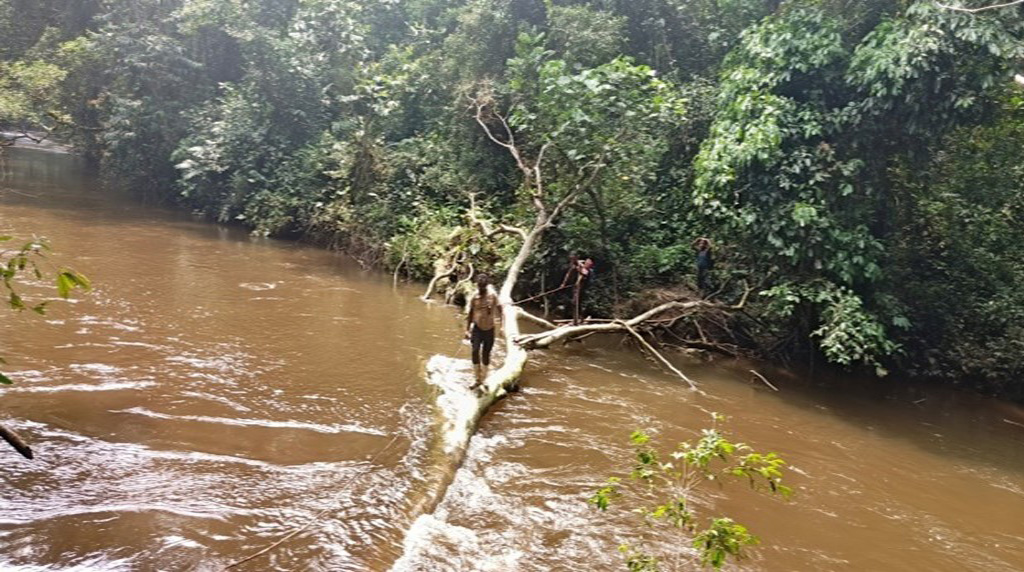
The river Angumo in the central sector of the Maiko National Park (© Papy Mahamudi Kabaya Eustache)
Due to its size, Maiko National Park (MNP) located in Democratic Republic of the Congo (DRC) gives the impression of being a small country. It is one of seven national parks in DRC, and was gazetted under the presidential order n°70-318 of November 30th 1970 in order to protect the huge forest area and its fauna.
The national park is abounding with biodiversity including endemic species like the eastern lowland gorilla (Gorilla beringei graueri), the okapi (Okapia johnstoni) and the Congo peafowl (Afropavo congoensis). It has a large population of chimpanzees as well as forest elephants. This vast national park is well known for its great diversity of socio-economical, ecological, political and even cultural realities; however, the local population has a different view.
This complexity comes from the park's history, geographic location and reachability, but mainly from its 10,830 km² surface. This has caused socio-economic and cultural setbacks for the riverine population trapped between their imperial ned of survival and the national park's strict conservation measures. The population is making demands and showing resistance to conservation activities because their socio-economic and cultural reality is rarely taken into consideration (Geisler 2003).
The armed conflict has had serious repercussions on gorilla conservation and more globally on the region's biodiversity. The eastern lowland gorillas living in DRC face increased threats due to human presence and hostilities in the central sector of Maiko National Park, widely known for hosting these gorillas.
Since 1989 the park has suffered from numerous armed conflicts, particularly in the central part. The different active armed groups include the Kachimuka group (Simba), Shiga-mpela, and Koni.
In 1995, the FDLR (Democratic Forces for the Liberation of Rwanda) from Tingitingi in the southern sector arrived in Maiko's central sector and settled temporarily at the Mandaye patrol post. Afterwards, young people from villages united to create local self-defence forces to fight them in the middle of the park. It was the beginning of the second conflict in Maiko following the one with the Ngilima group, an old group for self-defence that later became a Mai Mai group and ravaged the gorilla and elephant population in 1992.
Direct impact on gorillas
The occupation of forest zones by armed groups led to increased poaching for food and sometimes for military training activities (hunting and shooting). The direct consequences are a decline of the gorilla population as well as other emblematic species like okapi, elephant, chimpanzee, red colobus etc., thus weakening already vulnerable social groups.
Clashes in Maiko National Park between local armed groups and ADF-NALU (Allied Democratic Forces and National Army for the Liberation of Uganda) as well as human trespassing and the military presence in zones with a high gorilla density have fragmented the forest habitats, restricted the movement of gorilla groups and reduced their access to natural resources (nutrition, areas for reproduction), therefore increasing demographic and operational stress within these groups.
Conservation teams and local guides are targeted by poachers and armed groups whose interest is to exploit the resources of Maiko; it compromises monitoring and the fight against poaching activities.
Indirect impact on conservation
Environmental and natural resource degradation are aggravated by armed conflicts in this zone; we can witness forest degradation and ecosystems disturbance with no regard for the presence of gorillas and other species who need it for survival.
Gorilla tracks have been seen in Mabombi, Sombo, Kandabilo, Magwada and Abakanla in 2022 by trackers from FLOWADE (Loya Wandi Community Reserve for Development); today these gorillas are endangered by poaching practices. Degradation of habitats is pushing gorillas to migrate from Magwada Hill to Tabili and elephants to migrate from Lumpenje to Bayule and Tatufi.
Between May and October 2025, there was a noticeable increase in the poaching of gorillas and other species in the central and northern areas of Maiko. This was particularly evident in the Loya and Angamapasa groupements (administrative areas led by traditional leaders), within the Bakumu and Angumo sectors. Some poaching cases have been identified: on 18th of July 2025 one solitary male gorilla was killed by poachers in uniform in Kandabilo; on 13th of July 2025 in Maroc (mining claim) three elephants were killed; on 3rd of September one male gorilla was savagely killed in Mamwanyu; on 27th of September one okapi was killed in Magwada and Maroc.
These practices are in violation of natural resource conservation laws, specifically Law n°14/003 of February 11, 2014, concerning nature conservation. The areas most severely affected by armed conflicts in Maiko are Angumo, Magwada, Lompenje, Amamwanyu, Ombeni, Silte, and Kandabilo.
Threats by hunting, trade of baby gorillas, elephant trophies, okapi skin trade, and mining are escalating, resulting in increased degradation of gorilla habitats. This activity endangers protected rare species and contributes to the destruction of natural heritage, which is essential to humanity. Furthermore, this situation puts the entire human population in danger that relies on the ecosystem services that are crucial for the development of the Kivu region and the whole world.
Local Communities United for Nature and Development (CLUND), as a committed community-based organisation, is refusing to keep quiet, braving fears, and determined to denounce and inform everyone; they are urgently demanding an immediate intervention to stop these illicit activities that are endangering the future of communities as well as the future of humanity.
The ecocide in the central and northern parts of Maiko must not go unpunished, it is a crime against humanity. ICCN and its partners should by all means take action to stop the destruction of biodiversity in Maiko, natural home of the eastern lowland gorillas.
Papy Mahamudi Kabaya Eustache
References
Bahati Lukoo, E. (2025): La conservation au prix de ma jeunesse. Environews RDC
Bobia, J. (2025): la REDD en RDC une arnaque à l'africaine. P. 6. Révue Bimanshainfo
Chardonnet, B. (2019): L'Afrique change: ses aires protégées doivent-elles être evaluées? Reconfigurer les aires protégées en Afrique. ResearchGate of UICN.
Christol Paluku, M. (2005): Effectivité de la protection de la biodiversité forestière en RDC. Etudes Juridiques de la Fao en Ligne. P. 28
FLOWADE (2022): Rapport de la descente sur terrain. Juin 2022, 4
Geisler, C. (2003): Les expulsés du jardin d'Eden: un nouveau problème. Revue internationale des sciences sociales 175, 73
Maindo, A. (2017): Le parc de Maiko face à l'activisme des groupes armés. Tropenbos RD Congo. P. 37
ONU (2013): Rapport des Nations Unies, cartographie des groupes armés dans l'est de la République Démocratique du Congo. Research Group
Pélissier, C. et al. (2018): Les réseaux des aires protégées de la République Démocratique du Congo: Evaluation pour sa consolidation et son extension. UICN et WWF Kinshasa
Vallière, P. & Mandé, I. (2025): L'Afrique subsaharienne au temps de l'anthropocène; collection sociétés africaines en mutation. P. 60, 61. Presse de l'université du Québec