
Group Traits Influence the Relationship between Individual Social Traits and Fitness in Gorillas
Categories: Journal no. 71, Gorilla Groups, Ecology, Behaviour, Rwanda, Volcano National Park, Mountain Gorilla
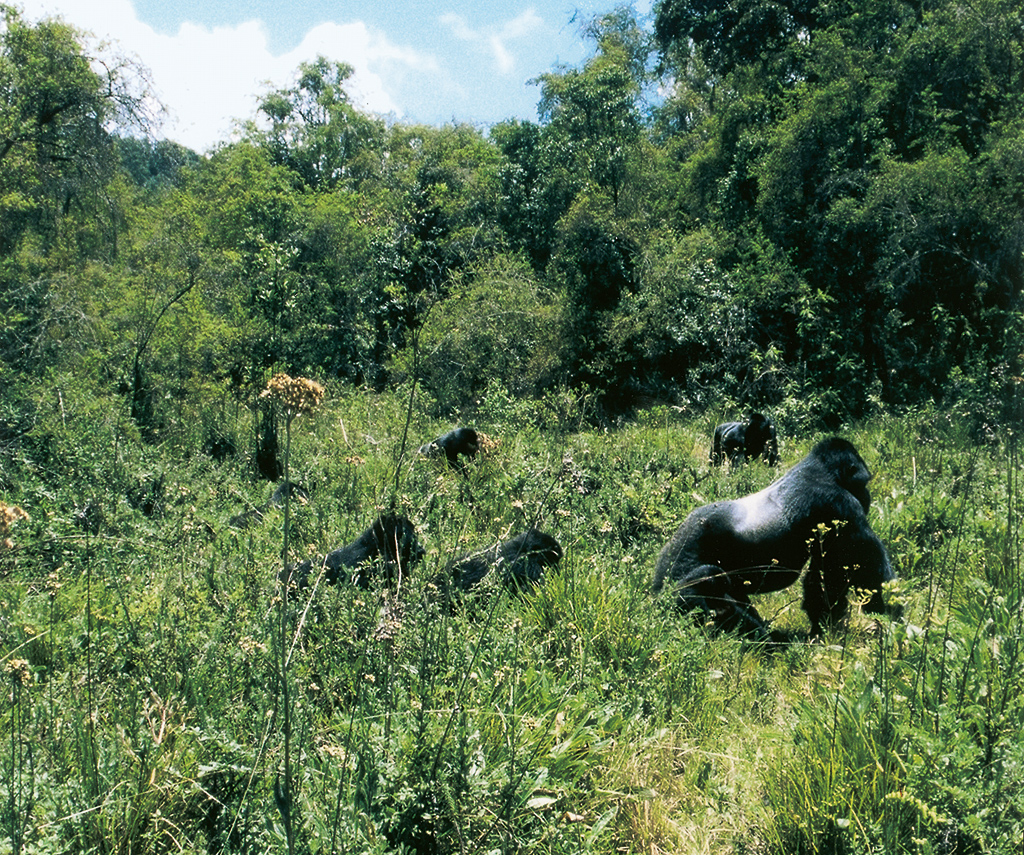
Mountain gorilla group in the Volcano National Park (© Cyril Grüter)
The social environment of an individual is strongly related to its fitness. In many social species, it has been shown that individual social traits, such as the strength of bonds, are linked to evolutionary fitness, reflected in birth rates, reproductive success or longevity. Many studies have investigated the impact of either individual social traits or group-level characteristics, such as group size, on fitness. However, it is largely unknown how the relationship of individual social traits and group-level traits affect fitness.
Using data from 21 years, researchers from the Dian Fossey Gorilla Fund and the universities of Exeter and Zurich examined how both individual social traits and group-level traits influenced the evolutionary fitness of 164 wild mountain gorillas in Volcanoes National Park, Rwanda. Amongst others, they investigated the impact of strength and stability of social bonds as well as group size and stability on fitness parameters, such as rates of illness and injury, birth rates and rates of illness and injury of dependant offspring.
The study showed clear sex differences in the costs and benefits of social bonds. Furthermore, the researchers showed that group-level traits modulated the effect of individual social traits on fitness. For female gorillas, having strong social bonds was related to lower rates of illness. However, for male gorillas, strong bonds were associated with higher rates of illness. This effect was strongest in unstable groups. At the same time, having strong social bonds was linked to lower injury rates in male mountain gorillas. Being in a large group was linked to lower rates of injury in male gorillas, whereas for female gorillas, it was linked to lower rates of illness. In small groups, females with strong bonds had lower rates of illness as well as lower birth rates. Infants of these females showed higher rates of illness. Whereas in large groups, females with strong bonds had higher rates of illness and higher birth rates. Infants of females in such groups had higher rates of injury.
Overall, the study shows how the social environment influences survival and reproduction of mountain gorillas. The social environment seems to affect survival rates in males more strongly than in females, which highlights the potential for sex-specific selection on social traits. Investigating multiple influencing factors, the study shows that several mechanisms seem to influence the relationship between social behaviour and fitness contributors, such as illness, injury, as well as reproduction. These mechanisms appear to be influenced by an individual's sex and age, and group characteristics seem to further modulate the impact of these mechanisms.
Taken together, the study demonstrates that social bonds come with both costs and benefits, resulting in potential fitness trade-offs in sociality. The researchers argue that the value of being social may depend a lot on an individual's sex, age, dependent offspring and traits of its social groups. Because of these varying costs and benefits, there is no one ‟best‟ way to be social, which may explain the wide range of social traits observed within species.
Original publication
Morrison, R. E., Ellis, S., Martignac, V., Stoinski, T. S. & Eckardt, W. (2025): Group traits moderate the relationship between individual social traits and fitness in gorillas. PNAS 122 (20), e2421539122