
Supervision of Trainees from Higher Education Institutions in Nature Conservation and Tourism
Categories: Journal no. 71, Tourism, Democratic Republic of the Congo, Mt. Tshiaberimu, Grauer's Gorilla
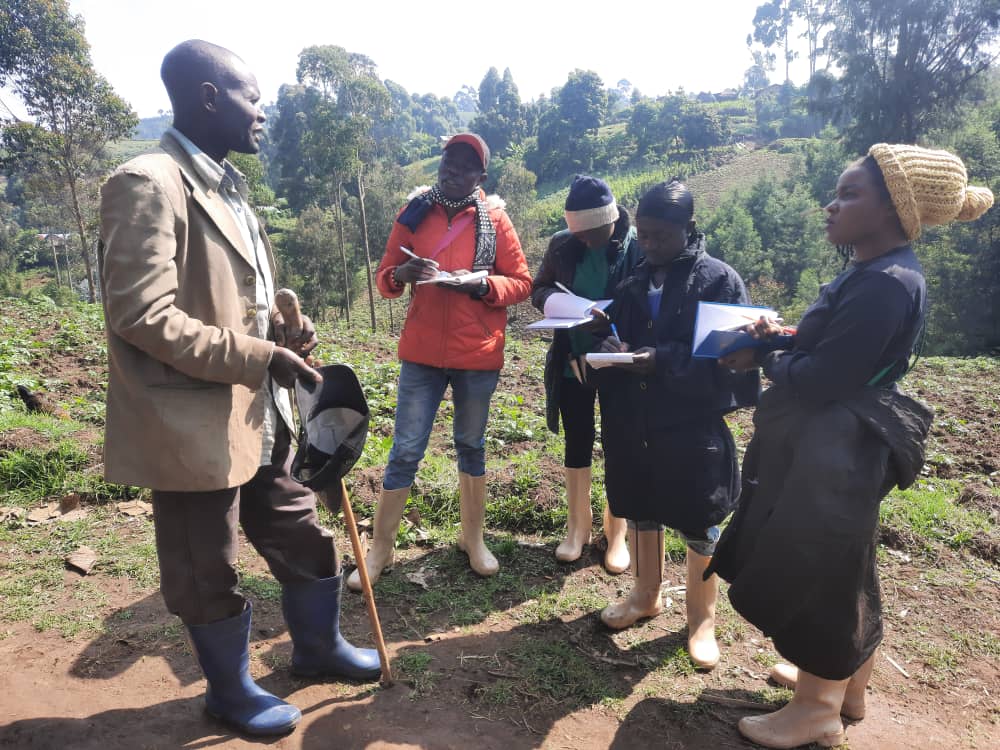
The students during a discussion in the field (© Kasereka Gervais)
For a long time, very few courses in environmental sciences, nature conservation and tourism have been offered in eastern Democratic Republic of the Congo and very few resources have been available to support them. Only a few institutions are able to secure sufficient funding to support student internships or training abroad. This situation often leads to the recruitment of staff with low levels of qualification in national parks.
Furthermore, institutions that supervise students in these fields face numerous difficulties in gaining access to conservation sites or protected areas. These obstacles arise not only from a lack of authorisation, but more importantly from insufficient financial resources, as protected areas are often located far from their institutions.
On the occasion of the launch of scientific workshops at universities and higher education institutions in North Kivu dedicated to the sustainable survival of Virunga National Park, a gap was identified in terms of practical training for students. This finding highlighted the importance of introductory and professional training courses within national parks and nature reserves. Several institutions supervising students in conservation courses expressed their desire to see their students undertake internships in protected areas in the Democratic Republic of the Congo. To this end, they contacted the Berggorilla & Regenwald Direkthilfe, which had already secured funding for a few students, to negotiate support for their interns.
As part of this professional internship, the mission consists of providing on-the-job training to students from the Higher Institute for Nature Conservation, Environment and Tourism in Rumangabo (ISCNET-R), particularly those in the second cohort of the Environment Management and Nature Conservation programme, in anti-poaching, gorilla monitoring and community awareness activities. By the end of this year, the students will design a leaflet and a calendar aimed at raising awareness and promoting knowledge of Mount Tshiaberimu and its gorillas.
The specific objectives of the internship are:
- Carry out monitoring work with eco-guards and trackers: learning the methods and use of GPS instruments, mapping, location techniques, etc.
- Raise awareness among the population to strengthen collaboration between the park and local communities; analyse the constraints and complaints of the population regarding the park.
- Participate in anti-poaching patrols.
- Understand and learn about the overall functioning of the park and its departments: administrative and technical organisation and the main activities carried out in the field.
To achieve these objectives, the students visited the headquarters of the northern sector of Virunga National Park (PNVi) in Mutsora and conducted fieldwork on Mount Tshiaberimu from 10 August to 4 September 2025. It should be noted that Mount Tshiaberimu is a sub-sector of the northern sector of PNVi. Data were collected using analytical, comparative and observational methods. For awareness-raising, they used participatory techniques. The choice of the northern sector was not random, as this sub-sector is where gorilla monitoring and anti-poaching patrols take place.
Internship schedule
The internship took place in two stages: The first stage involved fieldwork, during which activities consisted of monitoring gorillas, participating in anti-poaching patrols and raising awareness among the local population about conservation issues and peaceful coexistence. The second stage focused on the administrative and technical management structures of Virunga National Park in general, and more specifically on its structures in the northern sector of the park.
Two awareness-raising days were organised in six villages around Mount Tshiaberimu. These sessions reached 110 people and focused on peaceful coexistence between the park and the local population, crop damage caused by park animals, and the risk of zoonotic diseases. To date, there have been no confirmed cases of crop damage. When gorillas attempt to leave the park area, the local population immediately alerts the eco-guards, who come and drive them back to the park. Regarding the risk of zoonotic disease transmission, there has been no direct contact between the local population and the gorillas.
Participation in gorilla biomonitoring: the students took part in four biomonitoring patrols of the two gorilla groups on Mount Tshiaberimu, namely the Katsavara group, consisting of five individuals, and the Mwasa group, also known as Kipura, consisting of six individuals. They learned how to track gorillas, following their trail to the meeting point. At the meeting point, they observed the gorillas' activities, took notes, counted nests and observed droppings.
Participation in anti-poaching patrols: the students took part in a full day of anti-poaching patrols on 23/08/2025. From the Kalibina post, they set off towards the park boundary in the corridor known as Mulango ya Nyama. The team consisted of 17 people, including 6 soldiers, 3 eco-guards, 3 trackers and the students. At the entrance, they discovered and subsequently destroyed a cassava field measuring approximately 600 m2. A few hundred metres further on, they destroyed another cassava field covering nearly 2,000 m2. They continued to the other end of the boundary between the park and the village of Nguli. The patrol lasted from 6:30 a.m. to 5:15 p.m., covering approximately 14.62 km.
During the various activities mentioned above, the students handled different instruments: GPS devices, compasses, binoculars, cameras and walkie-talkies.
After the fieldwork, the students went to the Northern Sector headquarters for a briefing on how a national park generally operates and how a park sector is organised, using the Northern Sector as an example. They were informed about all the organisational structures of the administrative and technical staff.
In addition, they visited the various offices to learn about ICCN's partners, including the Virunga Foundation, Berggorilla & Regenwald Direkthilfe, GRACE, and relations with the surrounding community.
In conclusion, the trainees returned home with sufficient managerial skills in the scientific, technical and administrative management of a national park.
We would like to thank the donor who kindly supported this activity, namely GaiaZOO and Berggorilla & Regenwald Direkthilfe for their lobbying efforts.
Claude Sikubwabo Kiyengo