
Navigational Strategies of Western Lowland Gorillas
Categories: Journal no. 71, Ecology, Behaviour, Other countries, Other protected areas, Western Lowland Gorilla
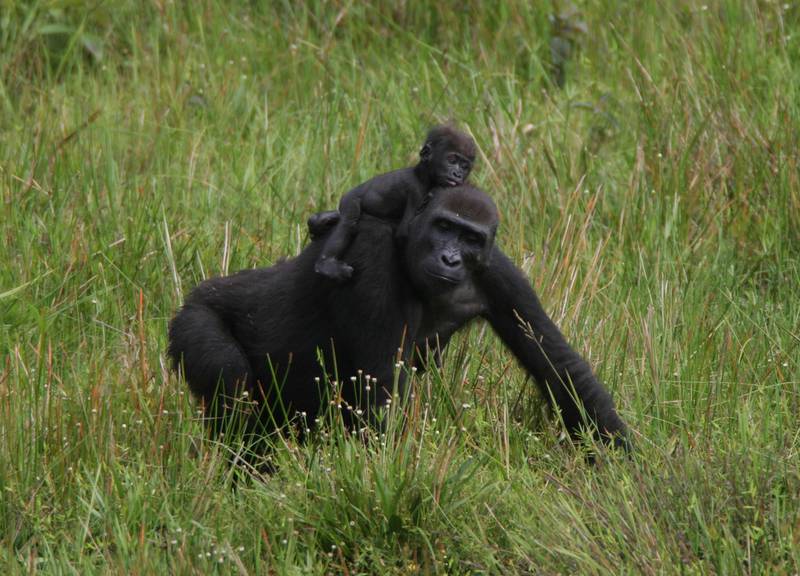
Petunia with her son Asta while visiting Mbeli Bai (© Thomas Breuer)
Food resources in tropical forests often occur in dispersed and ephemeral patches. To navigate efficiently to such patches and hence to forage efficiently, animals need a spatiotemporal memory. However, the way mammals efficiently navigate their home ranges are poorly understood.
Using tracking data from over 596 days, researchers investigated how one group of wild western lowland gorillas in Nouabalé-Ndoki National Park navigated its home range, both in everyday foraging and during long-distance foraging trips. Additionally, they examined whether the group used the sun to help them to do so.
The data showed that gorillas moved much longer distances to get to a swamp, containing important food resources. Furthermore, when gorillas made these long-distance foraging trips to the swamp, their movements were much straighter and faster than during everyday foraging on nearby patches. This implies that the group intentionally targeted the far away swamp using spatial memory and reflects a high motivational level to get to the swamp quickly. Taken together, these results suggest that western gorillas can efficiently navigate their home range. Additionally, the gorillas moved more directly when the sky was clear, even under the dense vegetation cover of the forest. However, the elevation of the sun, which can be used as a compass when being low, did not influence the path straightness. This implies that the gorillas did not use the sun's azimuth as a compass. Rather, they seem to rely on visual place recognition, using landmarks that are easier to detect under sunlight conditions.
According to the researchers, the study suggests that primates seem to use different kinds of navigational strategies, depending on the conditions they face. Thus, comparative studies of different primate species investigating the impact of various abiotic factors on movement patterns are needed to better understand navigational strategies in diurnal primates.
Original publication
Robira, B., Benhamou, S., Obeki Bayanga, E., Breuer, T. & Masi, S. (2024): Changes in movement patterns in relation to sun conditions and spatial scales in wild western gorillas. Animal Cognition 27, 37