
A Milestone for People and Wildlife: Usala Corridor Gains Formal Protection
Categories: Journal no. 71, Success Stories, Protective Measures, Democratic Republic of the Congo, Other protected areas, Grauer's Gorilla
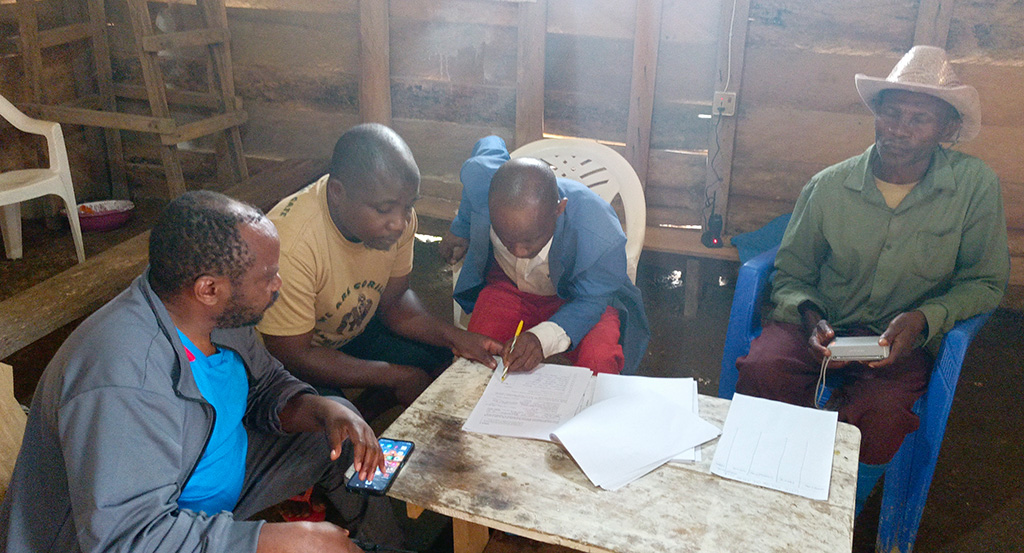
Local leaders sign Free, Prior, Informed Consent (FPIC) declarations. (© UGADEC/GRACE Gorillas)
Local communities in the Usala conservation corridor were formally awarded land tenure of their traditionally owned forests by the Provincial Government of North Kivu on August 14, 2025. These four Local Community Forest Concessions (CFCLs - Concessions Forestières aux Communautés Locales) create a contiguous corridor that connects Maiko National Park with Tayna Nature Reserve. This designation is a critical milestone in the protection of essential Grauer's gorilla, okapi, and forest elephant habitat.
Local communities have stewarded these forests with traditional land management systems for decades; however, these systems have been eroded by war and deteriorating quality of life and are increasingly threatened by mineral extraction and in-migration.
Seeking a permanent way to protect their traditional land tenure and forests, local leaders asked the North Kivu based organization UGADEC (Union des Associations de Conservation des Gorilles pour le Développement Communautaire à l'Est de la R. D. Congo) for support in gaining formal protection. Local communities' most favourable way to do this in the DRC is to apply for a Local Community Forest Concession (CFCL) from the Provincial Government. Now approved, this designation allows communities to manage their own land for long-term conservation and sustainable livelihood objectives. Notably, during the formal allocation review, Provincial authorities commended the thoroughness of community engagement, particularly the fact that no formal or informal complaints were received during the public comment period.
This unprecedented acknowledgment from the Provincial government was made possible because, prior to advancing CFCL applications, UGADEC, GRACE, and local community leaders undertook an inclusive, extensive, transparent, and truly village-level free, prior, and informed consent (FPIC) process. This 18-month FPIC process established community-wide understanding and support for the newly created CFCLs. This foundation of transparency and ongoing engagement is vital to achieving meaningful and effective conservation in the Usala corridor.
This extensive village-to-village level engagement was no easy feat. One of the reasons Usala remains intact and is such critical habitat for threatened and endangered species is that it is extremely isolated. Rama, the key village of Usala is a seven-day walk from GRACE sanctuary headquarters in Kasugho. To successfully work in this area, long field work periods have been required, as well as a focus on hiring and training local staff as much as possible.
‟This project is very important to me as part of UGADEC. We are committed to supporting communities and creating conservation zones, which reflects our vision of local people managing their own natural resources. For the communities, this project secures their forests and gives them the opportunity to manage them sustainably - for their well-being and for conservation.‟ Omer Palaku, UGADEC Executive Director
For Usala, this formal community forest designation is just the beginning. Efforts are now focused on developing conservation management plans, providing management committee capacity building, and sustainable community development strategies.
At the same time, biodiversity surveys of important fauna species are underway, with some of the regions' very first monitoring data being returned via satellite connection in the last few months. This preliminary data shows evidence of gorilla, chimpanzee, okapi, pangolin and more.
Timber and non-timber forest product inventories and community focus groups on resource use have also been completed. This information will enable local communities to delineate different land-use zones allowing for some land to be set aside for artisanal land use to improve local economies. The area's first socio-economic surveys are nearing completion, highlighting key needs for communities in the area, as well as opportunities for sustainable livelihood initiatives.
These developments - supported by communities, local government, project managers, and donors who believe conservation in Usala can go hand in hand with stronger local economies - show that empowering communities to protect their forests and wildlife is possible.
Jennifer Holland, Jackson Kabuyaya Mbeke and Omer Paluku
Special thanks to Maneno Kakule Ndavugha and Mitondo Hamisi Alain for their close collaboration with communities in conducting the extensive Free, Prior, and Informed Consent (FPIC) process. We also acknowledge the important support of RGU Coordinator Papy Zephirin Mahamudi Kabaya and GRACE Usala Project Manager Dominique Trésor Valyananzi.