Intensive Biomonitoring and Research in Maiko National Park during the First Half of 2025
Categories: Journal no. 71, Censuses, Democratic Republic of the Congo, Maiko, Grauer's Gorilla
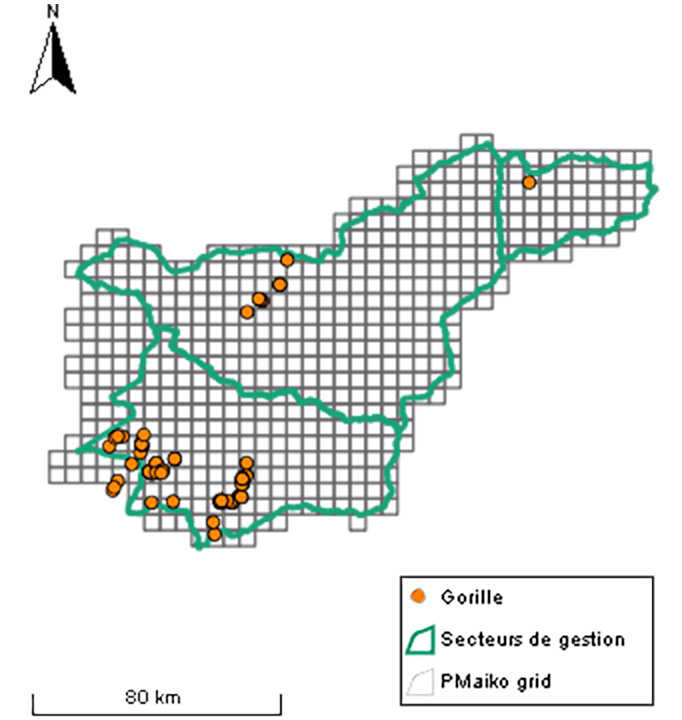
Gorilla distribution recordings during the patrols (© ICCN)
Maiko National Park (PNM), covering an area of 10,300 km², is the third largest park in the Democratic Republic of the Congo after Salonga National Park (36,000 km²) and Upemba National Park (11,730 km²). The PNM is a protected natural area that is home to a wide variety of flora and fauna. Its day-to-day management is based on the national biodiversity conservation strategy currently in force. Within the technical framework of the Anti-Poaching Fight, during the first half of 2025, field activities were made possible thanks to financial support from Berggorilla & Regenwald Direkthilfe, in order to ensure park surveillance, understand the ecological processes at play and assess the impact of human activities on the park's ecosystems. For the first half of 2025, the following objectives were targeted:
- Monitor changes in the park's biodiversity,
- Assess the impact of human activities on the park's ecosystems,
- Identify potential threats to the park's conservation,
- Develop technical strategies to mitigate anthropogenic pressure.
Research activities
It should be noted that research activities were carried out in the southern sector of the PNM, focusing on three topics:
- Contribution of endogenous knowledge to understanding and managing wildlife; case study of local communities in the southern sector of the park, Maniema Province.
- Abundance, distribution, habitat characteristics, and threats to Piliocolobus langi (red colobus) in the southern sector.
- Risk of contamination in the bush meat consumption value chain around Maiko National Park.
Twenty-three researchers from five institutions participated in this work, including five from the University of Kisangani, four from the University of Kinshasa, one from the National Veterinary Laboratory, one from the National Institute for Biomedical Research, and nine from Maiko National Park.
For the first topic, this study adopted an ethno-biological approach, combining qualitative and quantitative methods to collect and analyze information gathered on endogenous knowledge in the southern sector of the park, with a sample size of at least 80 respondents selected using snowball sampling and sociocultural quotas.
The study targeted four main sampling groups:
- Elders and traditional leaders (knowledge holders);
- Traditional hunters and fishermen (direct interactions with wildlife);
- Healers and practitioners of traditional medicine (medicinal use of animals);
- Women and young people (knowledge transmission and evolution).
ICCN (Institut Congolais pour la Conservation de la Nature) agents at the site are actively involved in the implementation of this study, as they participated in data collection, discussion of the results obtained, and the formulation of recommendations.
For the second topic, this study used the indirect census method, ‟Recce‟ or ‟reconnaissance trip‟, with patrols in tents to collect direct biological data (animals seen, vocalisations) or indirect data (observations of droppings, footprints, food remains, etc.) on Piliocolobus langi, its habitat, and threats. For each direct or indirect observation, the following data were collected: habitat type, canopy, undergrowth, slope, proximity to waterways, time of observation, animal species, types of threat, and altitude. The results obtained relate to the structural parameters of a population (relative abundance and encounter rate), statistical analysis of the data (correspondence factor analysis and ANOVA) and strategic analysis (SWOT matrix).
For the third topic, the study was just a field survey with a view to planning a more extensive study covering all sectors of the park.
Patrol efforts
There was a significant difference for February and March, given the insecurity in the country, which meant that there were no patrols in the northern sector. Furthermore, hostilities around the town of Walikale in January prevented patrols, as all park staff were on alert.
Patrol coverage
The number of quadrants covered describes the efforts made by patrols in the field to ensure the effective implementation of biodiversity management objectives. In total, patrols covered 121 quadrants measuring 5 x 5 km, equivalent to 29.4 %, and 293 quadrants measuring 2.5 x 2.5 km, equivalent to 17.78 % of the park's surface area.
Almost the entire central sector has not been monitored due to its remoteness, limited material and financial resources, and the presence of several rebel groups. These rebels do whatever they want: gold prospecting and mining for minerals, poaching, military training, etc.
Wildlife observation
Flagship species: These species are most demanding in terms of maintaining a key characteristic of their habitat. For Maiko National Park, there are five flagship species. They were observed during the first six months of 2025, with the okapi being observed frequently and the Congo peacock being rare. Their encounter rates are low in relation to the distance covered by the patrols. Based on the distribution maps, we can see that signs of okapi, gorillas, chimpanzees, and elephants have been observed in all areas of the park, unlike the Congolese peacock, which has only been observed in the northern sector.
Observations of other wildlife species
Species | Observations | Total | ||
Scientific name | Common name | dir. | indir. | |
Potamochoerus porcus | red river hog | 3 | 398 | 401 |
Cephalophus silvicultor | yellow-backed duiker | 1 | 350 | 351 |
Cephalophus dorsalis | bay duiker | 0 | 170 | 170 |
Cephalophus nigrifrons | black-fronted duiker | 0 | 30 | 31 |
Philantomba monticola | blue duiker | 1 | 57 | 58 |
Syncerus caffer | buffalo | 0 | 52 | 52 |
Tragelaphus spekii | sitatunga | 0 | 27 | 27 |
Tragelaphus eurycerus | bongo | 0 | 2 | 2 |
Hyemoschus aquaticus | water chevrotain | 0 | 65 | 65 |
Panthera pardus | leopard | 1 | 72 | 73 |
Smutsia gigantea | giant pangolin | 2 | 69 | 71 |
Cercopithecus mitis | blue monkey | 196 | 1 | 198 |
Cercopithecus ascanius | red-tailed monkey | 111 | 1 | 112 |
Cercopithecus mona | mona monkey | 67 | 0 | 67 |
Cercopithecus hamlyni | Hamlyn’s monkey | 30 | 2 | 32 |
Allochrocebus lhoesti | L’Hoest’s monkey | 24 | 1 | 26 |
Lophocebus albigena | grey-cheeked mangabey | 31 | 0 | 31 |
Piliocolobus sp. | red colobus | 6 | 0 | 6 |
Colobus guereza | black-and-white colobus | 2 | 0 | 2 |
Colobus angolensis | Angolan colobus | 1 | 0 | 1 |
Papio anubis | olive baboon | 1 | 0 | 1 |
Atherurus africanus | brush-tailed porcupine | 0 | 1 | 1 |
Hystrix cristata | crested porcupine | 0 | 1 | 1 |
Bitis gabonica | Gaboon viper | 1 | 0 | 1 |
Kinixys erosa | hinge-back tortoise | 1 | 0 | 1 |
Orycteropus afer | aardvark | 0 | 59 | 59 |
Human activities
Human activities in the PNM include hunting with 12-caliber firearms, trapping, digging for minerals, fishing, travelling between different villages and camps, and collecting non-timber forest products (NTFPs).
There is a permanent human presence in the park, as evidenced by the number of active camps and related activities, particularly hunting and trapping. The presence of armed groups in the park is also a factor in the destruction of biodiversity and a constraint on park management. As of August 18, 2025, the armed group known as the UPLD (Union of the People for Liberty and Democracy) had killed four elephants and, in October, three more elephants and five okapis, and wounded a gorilla, who charged his attackers after being injured (information from trackers at the Usala Gorilla Reserve). At this rate, there are fears that the flagship animals of Maiko will be wiped out, as the meat is sold but no one knows where the trophies are headed.
In early September 2023, eco-guards from Maiko South had clashes with Wazalendo living in the park. The latter disarmed the eco-guards. The weapons were recovered thanks to negotiations by government authorities.
Claude Sikubwabo Kiyengo